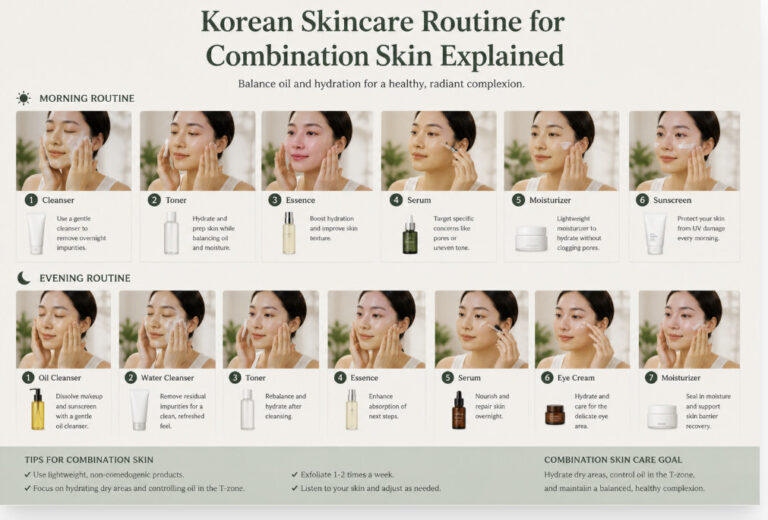
If you’re trying korean beauty tips at home for the first time, the hard part usually isn’t finding products, it’s figuring out which ones actually fit your skin instead of copying a 10-step routine you saw online.
This guide is written for someone who has never shopped Korean skincare before and wants a plain starting point: how to pick by skin type, which ingredients actually matter, what order to apply everything in, and where to buy the real thing.
I’ll also flag the 4 mistakes almost every beginner makes in their first month.
Korean skin care as a global category grew around this ingredient-first, skin-type-first habit rather than a fixed number of steps, so there’s no single ‘correct’ routine, just a correct starting point for your own skin.
How Do You Pick Korean Beauty Products by Skin Type?
Match your skin type to texture and key ingredients first, worry about brand names second.
Korean skincare leans on texture more than a lot of Western routines do, watery toners and gel moisturizers for oily or combination skin, richer creams and oil-based cleansers for dry skin.
When I started testing korean beauty tips at home, I kept buying whatever had the cutest packaging and ended up with 3 toners that were all too strong for my skin at the time.
| Skin Type | Look For | Usually Avoid |
|---|---|---|
| Oily or combination | Watery toner, gel moisturizer, niacinamide, green tea | Heavy balms, thick oils |
| Dry | Cream or oil cleanser, ceramides, hyaluronic acid | Foaming cleanser with alcohol |
| Sensitive | Centella (cica), fragrance-free lines, patch tests | Strong acids, high-percent actives |
| Normal | Lightweight layering, snail mucin, propolis | Stacking 8 or more products at once |
If your skin leans dry, the cleanser matters more than almost any other step, our Korean cleanser guide for dry skin breaks down specific picks by texture.
Which Ingredients Should You Check Before Buying?
Check the first 5 ingredients on the label, not the marketing claim on the front of the box.
Korean beauty brands often name a routine after one hero ingredient, but what matters is whether that ingredient sits near the top of the actual ingredient list.
These are common uses reported by brands and skincare communities, not medical claims, anyone with a diagnosed skin condition should check with a dermatologist before adding new actives.
| Ingredient | Commonly Used For | Good Starting Point For |
|---|---|---|
| Centella Asiatica (Cica) | Calming the look of irritated skin | Sensitive, reactive skin |
| Snail mucin | Hydration and smoother texture | Dry, dull skin |
| Niacinamide | Brighter look, oil control | Oily, combination skin |
| Ceramides | Supporting the skin barrier | Dry, sensitive skin |
| Propolis | Hydration with a glow finish | Normal to dry skin |
What Is the Right Order to Apply Korean Beauty Products at Home?
Go thinnest to thickest: cleanse, tone, treat, moisturize, protect.
This 5-step order is the core of most korean beauty tips at home routines, even for people who only use 4 products. Sunscreen is the one step people skip most, and it’s the one dermatology groups like the sunscreen literature consistently flags as the highest-impact daily step.
If you don’t want to buy every step at once, a slower, cheaper approach works fine too, see our Korean skincare routine on a budget guide for a shorter starter list.
Where Can You Buy Authentic Korean Beauty Products?
Buy from an official Korean retailer’s global site, a verified multi-brand retailer, or a real in-person pop-up, not an unverified marketplace listing.
Olive Young Global remains the widest online option for Korean skincare outside Korea, shipping to more than 60 countries.
As of a May 2026 policy change, the United States was moved off Olive Young Global’s direct-shipping list and now has its own separate Olive Young US store instead.
Sephora also announced a retail partnership with Olive Young in January 2026, so a growing number of Korean-exclusive items are showing up on Sephora’s shelves and site as well.
| Retailer | Ships To | Good For |
|---|---|---|
| Olive Young Global | 60+ countries (check current list) | Widest official selection |
| Olive Young US | United States only, since May 2026 | US shoppers after the shipping change |
| Sephora (in-store/online) | US and other Sephora markets | Curated Korean exclusives via the 2026 partnership |
| Multi-brand sites (YesStyle, Soko Glam, etc.) | Global | Lower order minimums, beginner-curated sets |
If you’re near New York, the Haus of K pop-up in Brooklyn has been letting visitors test Korean beauty and culture products in person, with its current run reported to close around November 28, 2026, a good example of how these temporary pop-ups rotate through major cities a few times a year.
Routines also shift with the seasons; if you’re shopping in colder months, our winter Korean skincare picks roundup covers richer options for that stretch of the year.
What Mistakes Do Beginners Make With Korean Beauty Tips at Home?
The most common mistake is skipping the patch test and layering too many new actives at once.
- Buying a full routine on day one instead of starting with 3 or 4 basics
- Skipping a patch test before trying snail mucin, acids, or strong serums
- Mixing several active ingredients at once instead of adding one every week or two
- Ordering from an unverified marketplace listing instead of an official store
FAQ
Do I need a full 10-step Korean skincare set to start?
No, most people only need a cleanser, toner, moisturizer, and sunscreen to start korean beauty tips at home, adding serums or essences later once they know how their skin reacts.
How do I know if a Korean beauty product is real and not fake?
Buy from the brand’s official store, an authorized retailer like Olive Young Global, or a well-known multi-brand site, and check that the batch code on the box matches the product listing.
Can I use a Korean skincare product meant for a different skin type?
You can, but results vary by person, so it’s safer to start with products matched to your own skin type and patch-test anything new on your inner arm first.
Where can I try Korean beauty products in person outside Korea?
Pop-up events are a good option, the Haus of K pop-up in Brooklyn, New York has let visitors test Korean beauty and culture products in person, with similar pop-ups appearing in other cities through the year.
Have you tried building a Korean beauty routine at home yet, or are you still figuring out your skin type? Share what’s worked or what tripped you up in the comments below.
Source: Editlab, https://editlab.luvpp.com
EDITLABPublished by EditlabA media network of 8 titles with free data tools.About the network ›
Written by the Editlab editorial desk · Automated pre-publication checks (duplicates, format, house rules) · Report an error · Add this site as a preferred source on Google
검색해도 내 집 사정과는 다를 때가 있습니다. 겪어 본 사람에게 직접 듣는 편이 빠를 때가 있습니다. 글은 누구나 읽을 수 있고, 질문을 남기려면 카페 가입이 필요합니다.