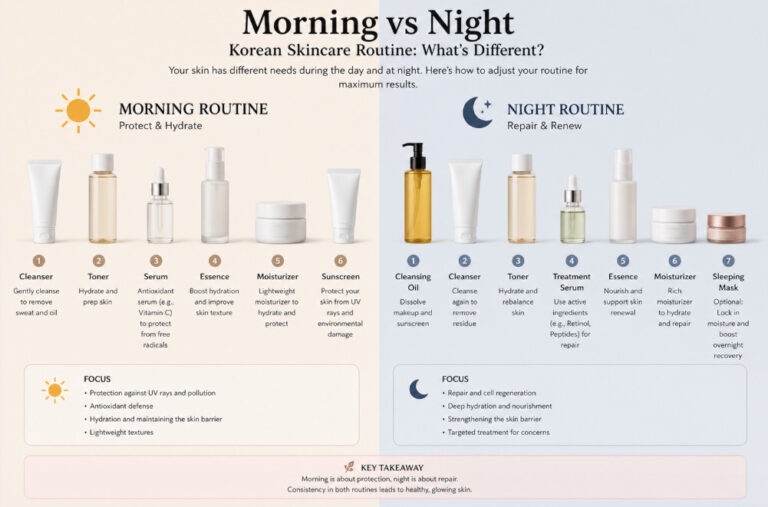
I used to think K-beauty trends were just another skincare fad that would fade after a season. Then I tried a simple three-step Korean routine for six weeks and my skin texture changed enough that coworkers asked what I was doing differently. That is the real reason K-beauty and K-fashion keep spreading: the results show up fast, and they are easy to copy without a plane ticket to Seoul.
This guide skips the theory and gets straight to what is working in 2026: which products and looks are worth the money, how to build a routine on a real budget, and why a recent global survey now calls Korean culture a lifestyle rather than a passing trend.
What K-beauty and K-fashion mean in 2026
K-beauty trends in 2026 center on skin barrier health and understated makeup, while K-fashion leans into oversized tailoring mixed with soft, muted colors. Both movements share one idea: less product, better technique.
A recent international survey reported that Korean culture no longer functions as a trend, but as an everyday lifestyle for a growing share of people outside Korea, spanning food, beauty, and clothing choices made weekly, not occasionally. That shift is exactly why K-beauty trends and K-fashion staples are showing up in ordinary wardrobes and bathroom shelves now instead of just on red carpets.
| Then (2019 to 2022) | Now (2026) |
|---|---|
| 10-step skincare marketed as the whole point | 3 to 5 step routines focused on barrier repair |
| K-fashion seen as concert or festival wear | K-fashion staples worn as everyday office and street looks |
| Interest tied to specific K-pop comebacks | Interest tied to ongoing lifestyle habits (skincare, food, style) |
The K-beauty trends worth your money right now
Three K-beauty trends dominate in 2026: cica-based barrier repair, glass skin makeup, and low-pH cleansing. Here is what each one actually does and what it costs to try.
Barrier repair over active overload
When I overused acids and retinol at the same time last year, my skin turned red and flaky within a week. Switching to a cica (centella asiatica) cream calmed it down in about four days. That trial and error is why barrier-first routines, not aggressive actives, are the biggest K-beauty trend of the year.
| Step | Product type | Typical cost (USD) |
|---|---|---|
| 1 | Low-pH gel cleanser | $12 to $18 |
| 2 | Cica or centella serum | $18 to $28 |
| 3 | Lightweight barrier moisturizer | $15 to $25 |
| 4 | Mineral SPF 50 | $14 to $22 |
Glass skin makeup, not glitter skin
Glass skin in 2026 means dewy but even, not shimmery. The trick that actually worked for me: pressing a hydrating cushion foundation with a damp sponge instead of a brush, which took my routine from cakey to dewy in under two minutes.
K-fashion staples people are actually wearing
The four K-fashion staples defining 2026 are oversized blazers, wide-leg trousers, layered knits, and minimal sneakers. None of these require a designer budget.
- Oversized blazer in muted beige or grey, worn slightly loose at the shoulder
- Wide-leg trousers cropped just above the ankle
- Thin layered knits instead of one heavy sweater
- Clean, low-profile sneakers in white or off-white
When I tried this combination for a work week instead of my usual fitted jeans, I noticed the biggest difference was comfort, not just looks. Wide-leg trousers moved better through a full day of walking and sitting than anything I owned before.
How to start K-beauty trends on a real budget
You can start K-beauty and K-fashion for under $80 by choosing one product per skincare step and one wardrobe staple per month. Trying to buy everything at once is the most common mistake I see and made myself early on.
| Common mistake | Better approach |
|---|---|
| Buying a 10-product set immediately | Add one new step every 2 weeks and watch your skin’s reaction |
| Copying an entire outfit at once | Buy one staple piece (blazer or trousers) and pair with items you own |
| Skipping patch testing new actives | Patch test on your inner arm for 48 hours first |
Why this is a lifestyle shift, not a trend cycle
Korean beauty and fashion are spreading alongside Korean food and music, which is why surveys now describe it as a lifestyle rather than a trend. Recent headlines about K-pop menu collaborations and rising demand for Korean restaurants outside Korea point to the same pattern: people are not sampling one Korean product, they are adopting a set of daily habits.
If you want the wider picture, this breakdown of Korean culture becoming a global lifestyle covers the food and entertainment side, and this look at K-pop’s global lifestyle influence explains how music fandom feeds directly into fashion choices. For background on how this movement started, the Korean wave (Hallyu) overview on Wikipedia is a solid starting point.
FAQ
Do I need Korean-brand products specifically for K-beauty trends to work?
No. The routine structure (low-pH cleanser, barrier repair, SPF) matters more than the brand. Korean brands are simply where these formulas were popularized first.
How long before I see results from a K-beauty routine?
Most people notice texture changes in 2 to 4 weeks and see clearer improvement by week 6, based on consistent daily use rather than occasional use.
Is K-fashion only oversized and loose fitting?
Not entirely. 2026 K-fashion mixes oversized outerwear with fitted basics underneath, so the silhouette stays structured rather than sloppy.
What is the cheapest way to try K-fashion staples first?
Start with one wide-leg trouser or one oversized blazer in a neutral color, since both pair easily with clothing you already own.
Source: Editlab, https://editlab.luvpp.com