I still remember standing in front of a wall of serums at an Olive Young in Myeongdong, holding a snail mucin essence in one hand and a centella serum in the other, with no idea which one my dry, easily-irritated skin actually needed.
This guide is for first-time K-beauty shoppers and travelers heading to Korea who want a simple, honest answer to korean skincare how to start: how to read your own skin type, what order to apply things in, and where to actually buy them without wasting money on the wrong bottle.
By the end you will have a starter routine of just 4 to 6 steps, a short ingredient list to look for, and a clear idea of whether to shop in a Korean store, through an app, or from outside Korea.
How Do I Start Korean Skincare As A Complete Beginner?
Start with your skin type first, then build a simple four-step routine before adding anything extra.
Korean skincare has a reputation for ten-step routines, but that is a ceiling, not a starting line.
Most Korean drugstores actually sell a basic lineup of cleanser, toner, moisturizer, and sunscreen, with serums and sheet masks added once you know what your skin tolerates.
For a general overview of the category, the Wikipedia entry on K-beauty is a useful starting reference.
My own shelf took about three months to settle into something I still use today, mostly because I kept buying products based on cute packaging instead of my skin’s actual signs. Skipping that trial and error starts with figuring out your skin type, covered next.
What Is My Skin Type In Korean Skincare Terms?
Korean skincare generally sorts skin into four working types: oily, dry, combination, and sensitive, and each points to different ingredients.
You do not need a dermatologist visit to get started, just a few days of watching how your face behaves with a bare cleanser and no products on top. Note where it shines, where it flakes, and whether new products sting.
| Skin Type | Common Signs | Look For | Use With Caution |
|---|---|---|---|
| Oily | Shine by midday, clogged pores | Niacinamide, light gel moisturizer | Heavy oils, thick balms |
| Dry | Flaking, tightness after washing | Ceramide, hyaluronic acid, squalane | High-alcohol toners |
| Combination | Oily T-zone, drier cheeks | Light essence, balanced gel cream | One heavy product on the whole face |
| Sensitive | Redness or stinging with new products | Centella asiatica (cica), panthenol | Fragrance, high-percentage acids |
If you want brand-level picks for each type, this guide to choosing Korean skincare products by skin type goes further than this starter overview.
What Order Do Korean Skincare Products Go In?
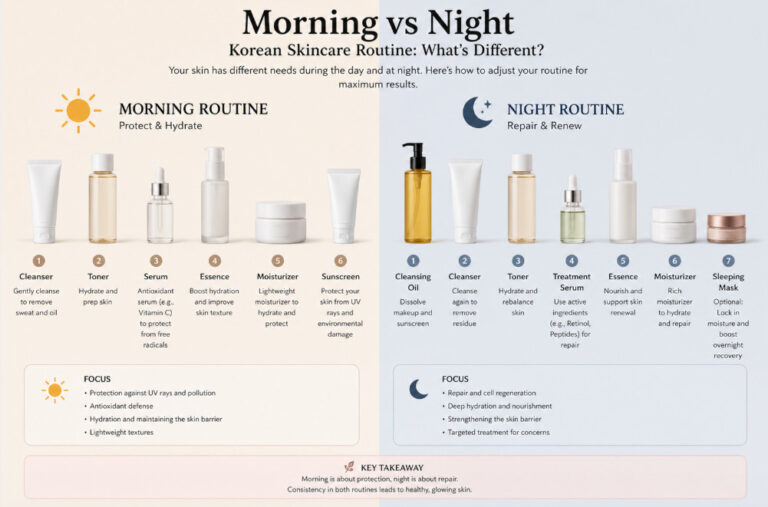
The simplified order is cleanse, tone, treat, moisturize, then protect, going from thinnest texture to thickest.
Each layer is meant to absorb before the next goes on, which is why Korean routines move from watery toners to thicker creams instead of the other way around.
| Step | Product Type | When |
|---|---|---|
| 1 | Oil cleanser, then gel or foam cleanser | AM & PM |
| 2 | Toner or light essence | AM & PM |
| 3 | Serum targeting your main concern | Usually PM |
| 4 | Moisturizer | AM & PM |
| 5 | Sunscreen | AM only |
| 6 | Sleeping pack or spot treatment | PM only |
Is The Full Ten-Step Routine Necessary For Beginners?
No, the ten-step routine is optional layering, not a requirement to start korean skincare.
A beginner-friendly split usually runs 4 steps in the morning and up to 6 steps at night, since sunscreen replaces several PM-only treatment steps.
Which Ingredients Should Beginners Look For Or Avoid?
Beginners generally do well starting with centella, niacinamide, ceramide, and hyaluronic acid, and holding off on strong acids at first.
These are information points, not medical claims, and reactions still vary by person, so patch-testing a new product on your jaw for two to three days before using it on your whole face is standard advice at most Korean beauty counters.
| Ingredient | What It’s Used For | Good Starting Point For |
|---|---|---|
| Centella asiatica (cica) | Soothing, calming formulas | Sensitive or reactive skin |
| Niacinamide | Brightening and oil control | Oily or combination skin |
| Ceramide | Barrier-supporting moisturizers | Dry or compromised skin |
| Hyaluronic acid | Hydrating, lightweight layering | Almost every skin type |
| AHA/BHA acids | Exfoliating treatments | Introduce later, 1 to 2 times a week |
Picking the right first cleanser matters as much as the serum you end up buying. This roundup of Korean facial cleansers by skin type is a good next stop before you shop.
Where Can I Buy Korean Skincare, In Korea Or Online?
In Korea, Olive Young and Lalavla stores are the easiest starting point; outside Korea, Olive Young’s own international site and major online marketplaces fill the gap.
One detail worth knowing before you order: as of May 2026, Olive Young moved its US customers to a separate Olive Young US site, while Olive Young Global continues shipping to more than 60 other countries, generally with free shipping once an order passes roughly $60 and with a handful of countries, including China, Russia, and Ukraine, excluded, according to the retailer’s own shipping notices.
Policies change, so it is worth checking the current terms on the official site before you order.
| Where | Best For | Notes |
|---|---|---|
| Olive Young / Lalavla stores in Korea | Widest selection, free testers | Staff can suggest items by skin type; English support varies by location |
| Duty-free or airport shops | Last-minute gift sets | Convenient but usually marked up |
| Olive Young Global (outside the US) | Shoppers in 60+ countries | Free shipping over about $60, typically 1 to 3 weeks delivery |
| Olive Young US, Amazon, or YesStyle | US buyers or smaller orders | Faster shipping, narrower selection than Korean stores |
What Mistakes Do Korean Skincare Beginners Usually Make?
The most common mistake is buying several active ingredients at once before the skin barrier has time to adjust.
- Starting with 3 or more active serums in the same week instead of adding one at a time
- Skipping sunscreen because the routine already feels like a lot of steps
- Buying a product because it’s trending online rather than matching it to a skin type
- Layering a heavy night cream under morning sunscreen, which can leave skin looking greasy by noon
- Assuming a sensitive-skin product works for everyone, when a patch test still matters
Frequently Asked Questions
Do I really need all 10 steps to start Korean skincare?
No, a basic 4-step routine of cleanser, toner, moisturizer, and sunscreen is enough to start; extra steps can be added once you know your skin type.
What’s the difference between a Korean toner and an essence?
Toner preps and balances skin after cleansing, while essence is a lighter, more hydrating treatment layered right after; many beginners use just one of the two at first.
Can I buy Korean skincare if I don’t live in Korea?
Yes, Olive Young Global ships to more than 60 countries outside the US, and separate marketplaces serve US and other international buyers, though selection is usually smaller than shopping in Korea.
Is Korean skincare safe for sensitive or acne-prone skin?
Many Korean brands offer fragrance-free, centella-based lines aimed at sensitive or acne-prone skin, but patch-testing any new product first is still recommended rather than assuming it will suit everyone.
Starting korean skincare does not require buying ten bottles on day one. Figure out your skin type, build a simple 4 to 6 step routine, and pick a shopping channel that matches your location and budget.
Have you already started building a K-beauty shelf, or are you still figuring out your skin type? Tell us where you got stuck in the comments.
Source: Editlab, https://editlab.luvpp.com
EDITLABPublished by EditlabA media network of 8 titles with free data tools.About the network ›
Written by the Editlab editorial desk · Automated pre-publication checks (duplicates, format, house rules) · Report an error · Add this site as a preferred source on Google
살림하다 보면 사소한 데서 막힙니다. 비슷한 상황을 지나온 분들에게 물어보실 수 있습니다. 글은 누구나 읽을 수 있고, 질문을 남기려면 카페 가입이 필요합니다.